Ongoing
Grasp-Anchored Cooperative Transport
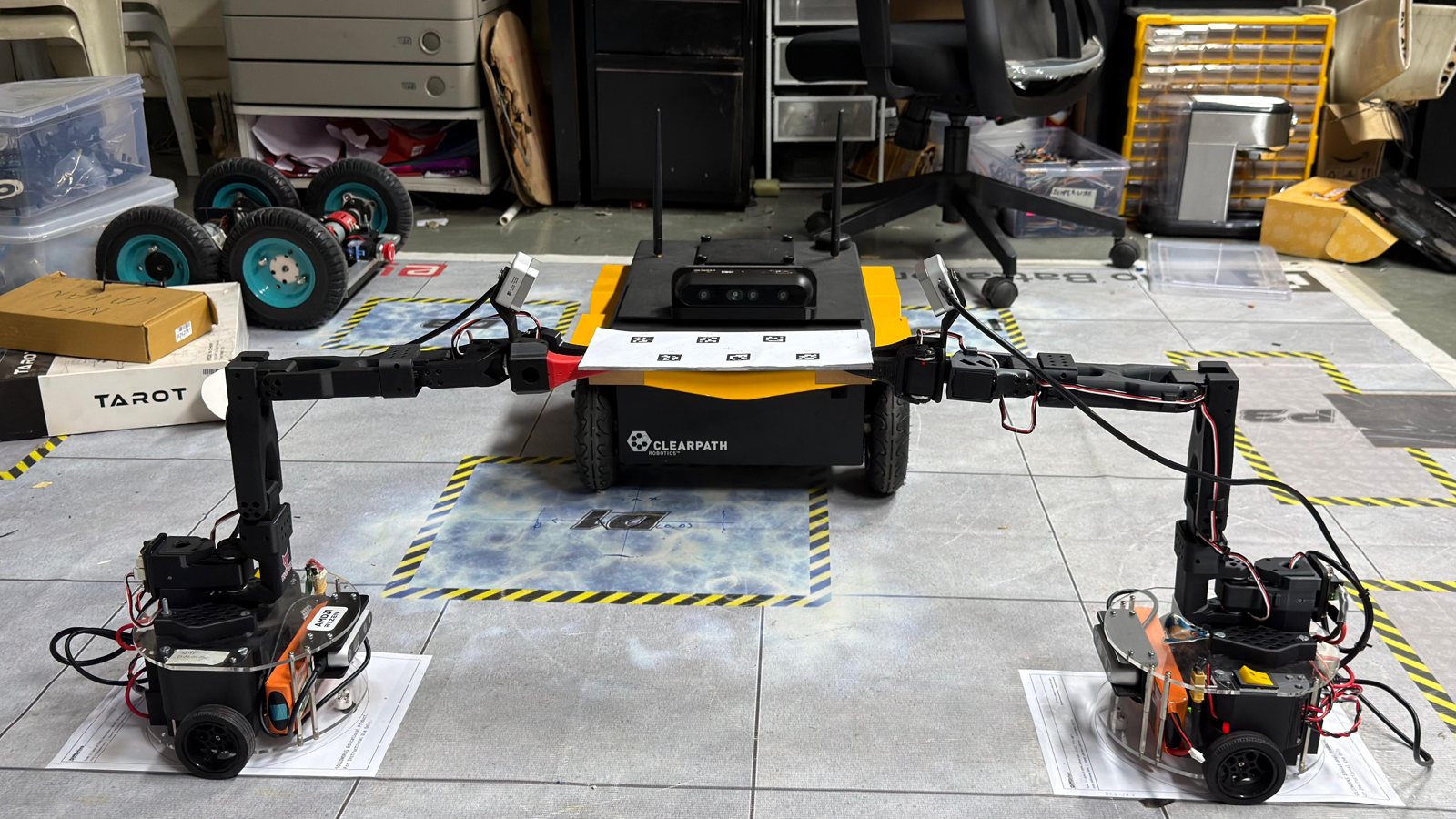
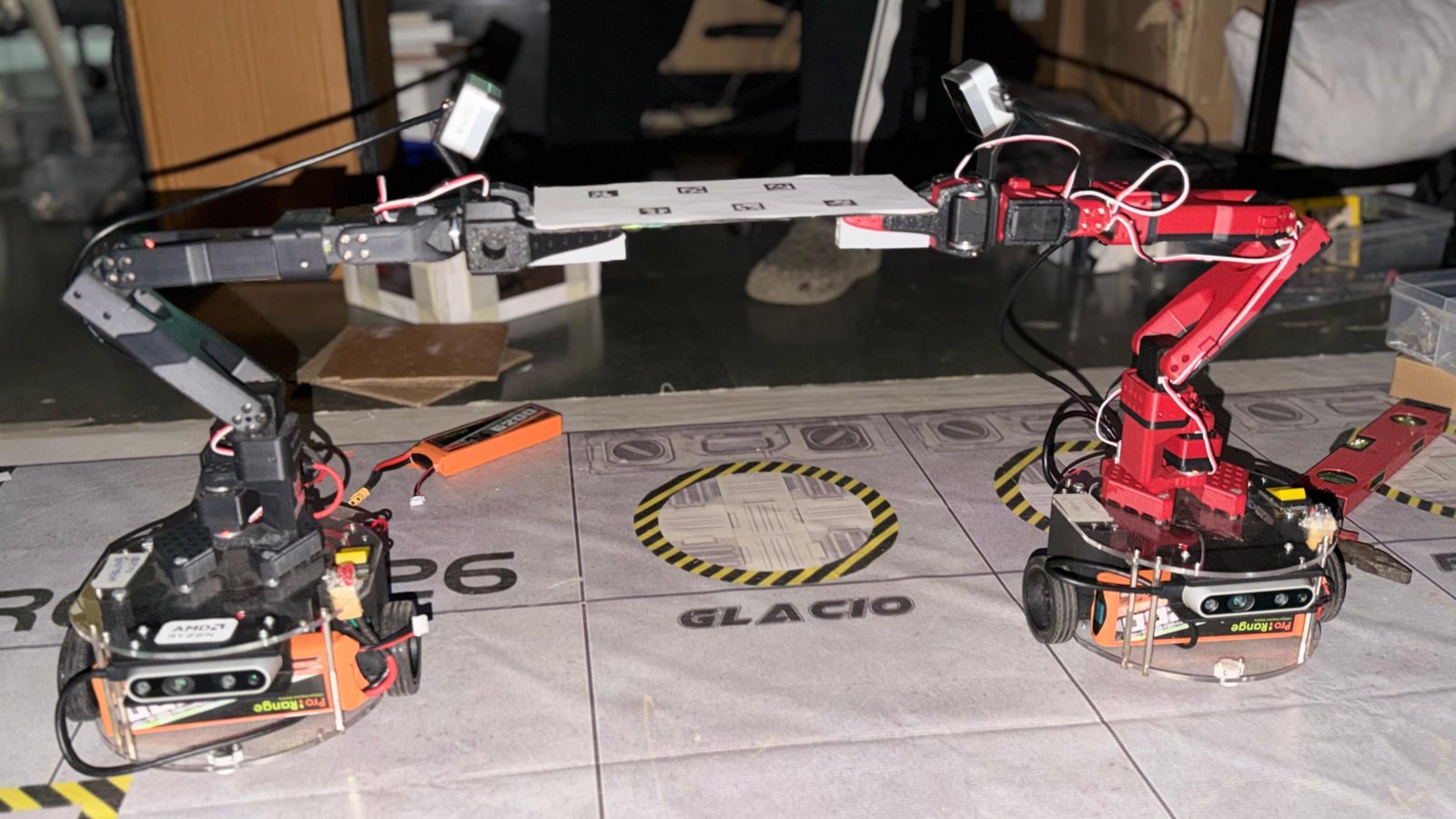
Two mobile manipulators carry one rigid payload, and the grasp itself tells each robot where its partner is.
- Mobile Manipulation
- Multi-Agent
- State Estimation
- Control
My contributions
- Posed planning and control in the payload frame, so transport depends only on the relative pose between the two robots.
- Recovered relative pose through the kinematic chain of the shared grasp, with an EKF on SE(3) running at 50 Hz on a Jetson Orin.
- Developed and tested a 14-DoF whole-body QP controller in MuJoCo simulation before deploying it on hardware, weighting the closed-chain constraint by the live estimator covariance.
Cooperative transport is usually shown with motion capture, a shared map or force/torque sensors at the grasp. This work removes all three. Two custom nonholonomic mobile manipulators carry a rigid payload using only onboard vision and decentralised compute.
Planning in the payload frame
Planning and control are posed entirely in the payload frame, so transport depends only on the relative pose between the two robots. Global localisation reduces to a coarse, landmark-based estimate of where the payload and the bases sit in the workspace.
Relative pose from the grasp
Relative pose is recovered through the kinematic chain of the shared grasp, not from odometry. This makes relative orientation, the channel where error strains the grasp, immune to wheel slip and map drift.
An EKF on SE(3) estimates each grasp transform with χ² innovation gating, running at 50 Hz on a Jetson Orin from 30 Hz wrist-camera detections.
Whole-body control
A 14-DoF whole-body QP carries the closed-chain constraint as a soft cost, weighted by the live estimator covariance. When the estimate degrades, the coupling relaxes, so the solver stays feasible mid-transport.
The controller and the planner were first developed and tested in MuJoCo simulation, then deployed on the real robots.
Gallery